Monday, May 9, 2016

Week 7 - Neurosci + Art

Before the lectures this week, I did not realize that neuroscience and art had such a strong connection, or any connection whatsoever. According to Giovanni Frazzetto and Suzanne Anker, “Artists in particular draw on publicly available references that illustrate, among other things, scientific images and the natural world. In neuroculture, such references specifically describe knowledge about the brain and mind” (Anker and Frazzetto). Artists are able to covey neuroscience to the public to help us understand both the complexity and beauty of our minds and bodies. Frazzetto and Anker’s idea becomes vey clear when you look at Suzanne Anker’s fMRI Butterfly and Jeff Lichtman’s Brainbow.
Anker took 15 fMRI scans of the human brain with the image of a butterfly in the center and different inkblots superimposed on the butterfly. “The overlays of the butterfly, MRI scans and inkblots yield nuanced variations in figure—ground relationships, creating in the viewer subtle optical illusions . . . although the butterflies are identical in each print, they seem different from one another” (Anker and Frazzetto). She created these superimposed images to show the core neurological processes and how they alter perception.
                   
                               
                                                                                   https://www.youtube.com/watch?v=nJlf5SB38pk

Of the different neuroscience art we looked at, Lichtman’s Brainbow is my favorite. “The brainbow system, a sophisticated transgenic technique, provided extraordinary pictures of neuronal circuitry, rivalling artistic representations” (Anker and Frazzetto). The brainbow uses a process by which individual neurons in the brain can be distinguished from neighboring neurons using fluorescent proteins, which light up in different colors. Not only does this help scientists locate, view, and track different neurons for easy study, but the brain scans have a beautiful and bright array of colors that depict how amazing the processes are that go on in our brains.

                                                                          https://www.youtube.com/watch?v=IZCZV5-v3S4

The use of art to display neuroscience gives the public an idea and visualization of the complicated processes that go on within our minds and bodies. “The interaction between art and science offers an opportunity to make the scientific community and the public aware of the social and ethical implications of the scientific advances in neuroscience” (Anker and Frazzetto).

"Minds Wide Open"
http://news.vanderbilt.edu/2012/04/neuroscience/


Citations

Anker, Suzanne, and Giovanni Frazzetto. "Neuroculture." 2009. MS Volume 10, Nature Reviews. N.p.

Gardner, Howard. "Art, Mind, And Brain: A Cognitive Approach To Creativity." Google Books. Howard Gardner, 1982. Web. 10 May 2016. 
          <https://books.google.com/books?id=2BMDYRRF1WcC&dq=gardner%2B%22art%2Bmind%2Band%2Bbrain%22&printsec=frontcover&source=
          web&ots=DYaIMCGy4j&sig=8yrvOMWISopSrN_fNXsYqUPJCgw&hl=en#v=onepage&q=gardner%20%22art%20mind%20and%20brain%22&f=false>.

Gorman, James. "Brains as Clear as Jell-O for Scientists to Explore." The New York Times. The New York Times, 10 Apr. 2013. Web. 10 May 2016. 
          <http://www.nytimes.com/2013/04/11/science/brains-as-clear-as-jell-o-for-scientists-to-explore.html?_r=0>.

Lichtman Et Al., and Livet Et Al. "Brainbow." Center for Brain Science. Harvard University, n.d. Web. 10 May 2016. 
          <http://cbs.fas.harvard.edu/science/connectome-project/brainbow>.


Lichtman, Jeff. "The Brainbow." DNA Learning Center. Cold Spring Harbor Laboratory, n.d. Web. 10 May 2016. <https://www.dnalc.org/view/2063-The-
          brainbow.html>.

Saturday, May 7, 2016

Event 2 - "Drone Sweet Drone"

            For my second event I went to Anne Niemetz’s Drone Sweet Drone exhibition, which focuses on the union of art, science, and technology. Niemetz is a media artist and she particularly works with interactive installations and audio-visual design.

            During the exhibition I had the chance to speak with Anne Niemetz about her inspiration for this art installation. Her main reason was the drone technology itself. For example, how it is normal to have hobby drones for everyone, how Amazon wants to deliver with drones, and the many uses drones have with warfare technology. In our conversation, Niemetz mentioned that drones can have “concerning sides, and as a media artist, one of the things we should be doing is looking at the ramifications of this technology.” Initially, I had a hard time grasping the meaning of her work, but after speaking with her, I felt like I understood each part of the installation. Her inspiration to raise concern about the drone technology is very important because of the increase in life-threatening incidents and privacy interruptions. You hear more and more about drones flying close to planes that are landing or taking off and threatening the lives of all the passengers inside. Celebrities have drones flying in their backyards taking away the privacy of their own home, even I have seen a drone fly over my house. Not to mention the increased use of drones in modern warfare technologies. Niemetz’s installation touched on the many different uses of drones. The embroidered drones each had a unique sentence to tell one of the uses for a drone, like “I AM YOUR PLAYTHING,” “TRUST ME,” and “I FOLLOW YOU.” They had different light patterns as well to demonstrate the different purposes. The “TRAIN ME” drone had a random light pattern to show that it was somewhat “all over the place.”


            I do agree with Anne Niemetz that we need to have caution with these drones and all of the different uses they have because of the threats they are posing to human well-being. This exhibition fits perfectly into our art and technology topic. Her artistic representation of the drones through embroidery and LED lights represent the uses for this new technology.


Thursday, May 5, 2016

Week 6 - BioTech + Art

          The lectures this past week brought to light many different aspects for how biotechnology and art are connected and used together.  I know that biotechnology is a process to harness “cellular and biomolecular processes to develop technologies and products that help improve our lives and the health of our planet” (Biotechnology Innovation Organization), but I did not realize artists were so involved with this science to create art. While art pieces like Eduardo Kac’s fluorescent bunny and Marta de Menezes’s genetically modified butterfly wings are innovative and jaw-dropping artworks, I am not sure I believe that living species should be modified for the purpose of an art piece.

GFP Mice
https://en.wikipedia.org/wiki/Green_fluorescent_protein
Alba
http://www.ekac.org/gfpbunny.html
          Kac’s fluorescent bunny, Alba, seems very similar to Osamu Shimomura’s EGFG mice, but there is a big difference. Shimomura’s glowing mice were created to help “scientists find and study gene’s more quickly” (Herper). Shimomura’s experiment embodied the true definition of biotechnology. The purpose of injecting the jellyfish green fluorescent protein into the cells of these mice was to study biological processes and diseases to help improve health and understand how some diseases work. On the other hand, Kac used these same processes for the purpose of transgenic art. Kac states that he is “not interested in the creation of genetic objects, but on the invention of transgenic social subjects” (Kac). Alba was not for the purpose of helping improve lives, it was to see how a genetically engineered subject would react and interact with society.


          Similar to Kac, Marta de Menezes genetically modified an organism for art. She decided to change the patterns on live butterfly wings for artistic purposes. By genetically modifying these living creatures, we disrupt the natural process of evolution. Bunnies are the way they are because of evolution. Butterfly wing patterns have that particular pattern because of evolution. All creatures today are evolved to serve a certain purpose, so when we change the natural being, we completely disrupt the many years of evolution. I do not believe this is justified for the creation of an art piece.
GM Butterfly
http://martademenezes.com/portfolio/projects/
          There should be limits to human creativity. Innovation and creation is very important for the purpose of moving forward in health and other similar fields, so I support the use of GMOs and other biotechnology in this way. But modifying a living organism for the sole purpose of creating art seems wrong. Due to the growing experimentation with animals and creating hybrids, I believe that there is a need for separate standards for artists creating or manipulating living organisms.


Citations
Herper, Matthew. "Biotech's Glowing Breakthrough." Forbes. Forbes Magazine, 26 July 2001. Web. 05 May 2016.  
          <http://www.forbes.com/2001/07/26/0726gfp.html>.

Kac, Eduardo. "GFP BUNNY." Ekac.org. N.p., 2000. Web. 05 May 2016. <http://www.ekac.org/gfpbunny.html#gfpbunnyanchor>.

Menezes, Marta De. "Nature?" Marta De Menezes. Marta De Menezes by Moshi Moshi, n.d. Web. 05 May 2016. <http://martademenezes.com/portfolio/projects/>.

O'Mathúna, Dónal P., PhD. "The Role of Art in the Genetic Age." The Center for Bioethics & Human Dignity. N.p., 07 July 2002. Web. 05 May 2016. 
          <https://cbhd.org/content/role-art-genetic-age>.


"What Is Biotechnology?" Biotechnology Innovation Organization. BIO, n.d. Web. 05 May 2016. <https://www.bio.org/articles/what-biotechnology>.

Sunday, April 24, 2016

Event 1 - Art + Science Through Restoration and Conservation

            For my first event, I decided to look further into the topic of art, science, and technology. Throughout the lectures, we mainly focused on how mathematical principles are used by artists to create their final piece, how technology and robots could create art or destroy its authenticity, and the ways in which anatomy and dissection sit at the intersection of art and science. I wanted to expand on these ideas of how art and science are related. The relationship between art and science is not only important in creating a final product, but also maintaining it for future generations to see. Numerous restoration and preservation techniques utilize chemical properties in order to properly maintain the artwork.
Mona Lisa Reconstruction Steps
https://ceroart.revues.org/3828
            I chose to go to the Getty because of the Getty Conservation Institute (GCI), which uses and develops scientific advances to preserve and restore art of all ages. Some of the many types of conservation, restoration, and examination techniques include ultraviolet illumination, X-ray fluorescent spectroscopy, scanning electron microscopy, infrared imaging, raman spectroscopy, laser ablation, etc. The gleaming white buildings and pristine paintings in the Getty often times overshadow the tireless efforts of the conservation institute; however, without these modern scientific advancements in preservation many of the beloved masterpieces by Van Gough, Monet, Picasso, and others would be lost in history. Preservation allows artwork to transcend generations and, in doing so, allows modern day society to “paint a picture” of the life long ago. The Getty’s conservation institute opened my eyes to the difficulty of artistic preservation and viewing the fabulous artwork helped me to understand its importance.

The Getty Conservation Institute

An Inside Look at GCI

            Scientists and artists team together to keep art in the most pristine condition possible. The mixing of chemicals and inventions of new technological devices to preserve and restore art require the knowledge and ability of renowned scientists and art experts to work together.


Citations

Bagwell, Sam. "The Beauty of Science: New Technologies in Art Restoration." USC Viterbi. Illumin, 08 Dec. 2004. Web. 23 Apr. 2016. 
            <http://illumin.usc.edu/34/the-beauty-of-science-new-technologies-in-art-restoration/>.


"Getty Conservation Institute (GCI) | The Getty." Getty Conservation Institute. The J. Paul Getty Trust, n.d. Web. 23 Apr. 2016 
            <http://www.getty.edu/conservation/>.


Proof of Event

Me at Getty Conservation Institute (GCI)
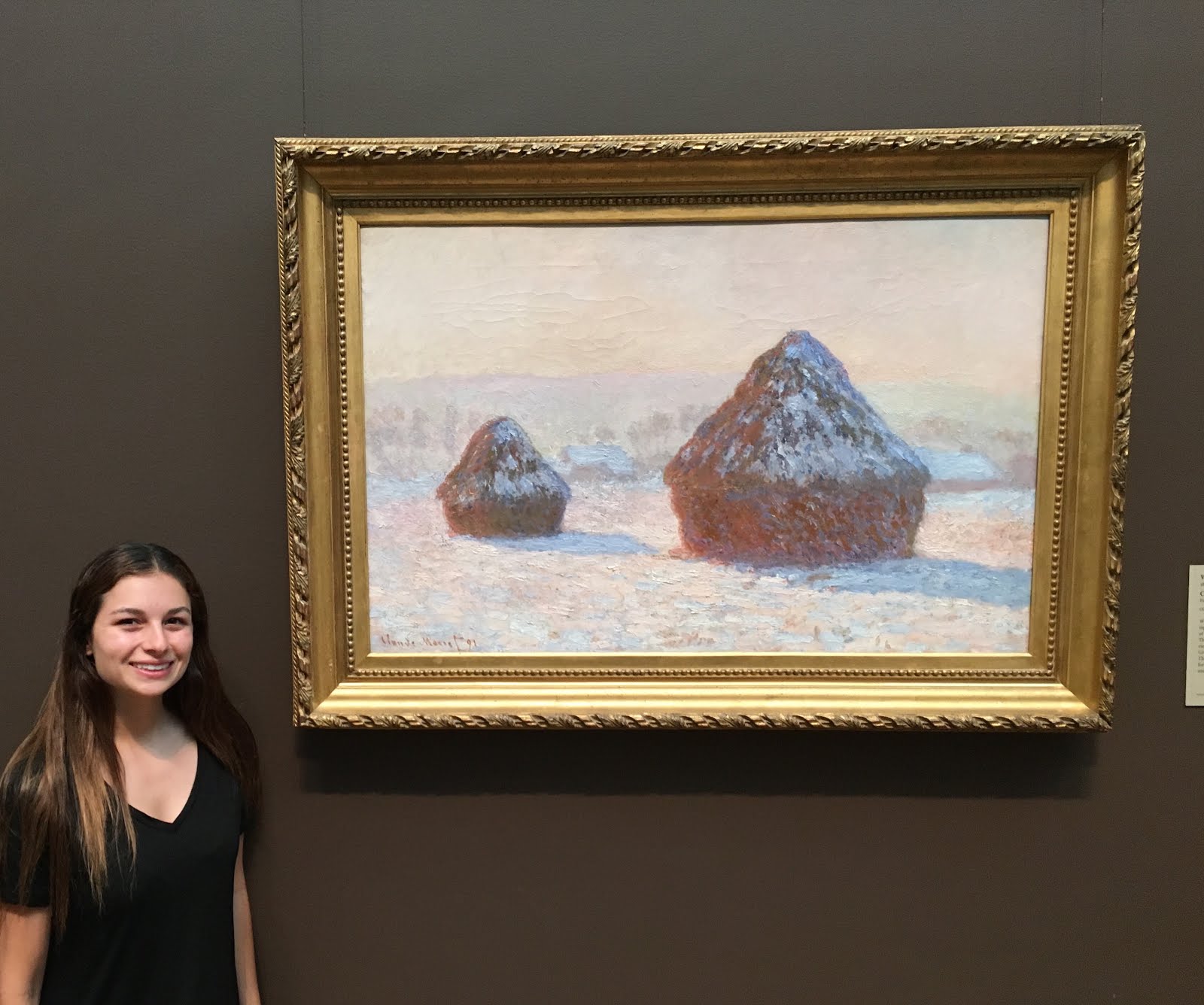
Me in front of Monet's Wheatstacks, Now Effect, Morning
Me with worker at The Getty
My parking ticket to prove the date